
If you’ve ever found yourself caught in loops of worry, overthinking, reassurance-seeking, or intrusive thoughts that just won’t let go, you may have wondered: Is this anxiety, or could this be OCD?
Anxiety and OCD can overlap in ways that feel confusing and exhausting. Both can leave you feeling mentally stuck, emotionally overwhelmed, and constantly searching for relief or certainty. You might find yourself replaying conversations, researching symptoms late at night, questioning your thoughts, or trying to “figure something out” over and over again — only to feel temporarily better before the anxiety returns.
Because the two experiences can look similar on the surface, many people initially assume they are “just anxious,” without realizing that obsessive-compulsive patterns may also be part of what’s happening.
Understanding the difference is not about labeling yourself or pathologizing every anxious thought. Often, it is simply about making better sense of your experience – and understanding why certain patterns can feel so difficult to break on your own.
Anxiety and OCD Can Look Similar
Anxiety and OCD share many overlapping features, which is part of what can make the distinction confusing.
Both can involve:
- racing thoughts
- fear and uncertainty
- physical symptoms of anxiety
- avoidance behaviours
- excessive mental checking or overthinking
- difficulty “letting go” of distressing thoughts
You may notice yourself becoming consumed by certain fears or questions, constantly trying to find reassurance or certainty. For some people, this can look like worrying about health, relationships, mistakes, safety, or whether they’ve done something wrong. Others may feel trapped in repetitive thought patterns that are difficult to stop, even when they logically know the fear may not fully make sense.
Both anxiety and OCD can feel mentally exhausting. They can pull you out of the present moment and create a constant sense of tension, vigilance, or emotional overwhelm.
Because the experiences overlap in so many ways, OCD is often misunderstood or missed entirely.
One Key Difference: The Role of Compulsions
One of the biggest differences between anxiety and OCD is the role of compulsions.
Compulsions are things you feel driven to do in order to reduce anxiety, feel more certain, or prevent something bad from happening. Sometimes these behaviours are visible – like checking, washing, or repeatedly asking for reassurance – but many compulsions happen internally and can be much harder to recognize.
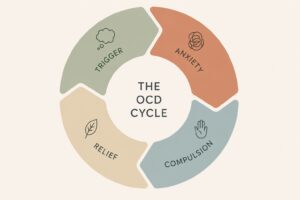
For example, you might:
- mentally replay conversations trying to “make sure” you didn’t do something wrong
- repeatedly google symptoms or search for certainty online
- constantly check how you feel emotionally
- seek reassurance from people you trust
- avoid situations, people, or topics that trigger doubt or fear
Often, these behaviours make complete sense in the moment. When anxiety feels overwhelming, it is very human to reach for certainty, reassurance, or relief. The difficult part is that compulsions usually only soothe the anxiety temporarily. Over time, the cycle tends to become stronger, not weaker.
For some people, working with a therapist trained in OCD therapy in Vancouver or ERP treatment can help interrupt these patterns and create a different relationship with uncertainty and fear.
Why OCD is Often Misunderstood as Anxiety
Many people think of OCD only in terms of visible compulsions or stereotypes around cleanliness and organization. In reality, OCD can be much more internal – and much easier to hide.
Some people experience intrusive thoughts that feel deeply upsetting or inconsistent with who they are. Others become stuck in cycles of doubt, reassurance-seeking, researching, checking, or mentally reviewing things over and over again. From the outside, it may simply look like anxiety or overthinking.
Because compulsions are not always visible, many people spend years assuming they are “just anxious” without realizing obsessive-compulsive patterns may also be present.
One of the most painful parts of OCD is often the search for certainty. You may feel an overwhelming need to know for sure:
- whether you are safe
- whether you made the right decision
- whether a thought means something important
- whether something bad could happen
- whether you are “really” okay
Unfortunately, certainty is rarely fully attainable. The harder someone tries to eliminate uncertainty completely, the more trapped and consumed they often begin to feel.
Intrusive Thoughts Do Not Define You
One of the most distressing parts of OCD and anxiety can be the experience of intrusive thoughts.
These thoughts can feel upsetting, confusing, or frightening. Many people worry that having a thought means something important about who they are. Others become terrified that a thought might secretly reflect a hidden desire, intention, or danger.
But thoughts are not the same thing as intentions.
In fact, people are often distressed by intrusive thoughts precisely because the thoughts conflict with their values, identity, or sense of safety. The fear, shame, and self-doubt surrounding these experiences can sometimes lead people to suffer quietly for years without speaking openly about what they are going through.
If this is something you’ve experienced, you are far from alone.
Intrusive thoughts are much more common than many people realize, and struggling with them does not make you dangerous, broken, or fundamentally flawed. Often, the problem is not the existence of the thought itself, but the fear, meaning, and urgency that become attached to it.
How Therapy Can Help
Therapy for OCD and anxiety often focuses less on eliminating thoughts completely, and more on changing the way you respond to them.
Approaches such as Cognitive Behavioural Therapy (CBT) and Exposure and Response Prevention (ERP) can help people gradually reduce compulsive cycles, tolerate uncertainty more effectively, and develop a different relationship with fear and intrusive thoughts.
This may involve learning how to:
- notice anxious thoughts without becoming fully consumed by them
- reduce compulsive checking or reassurance-seeking
- respond differently to uncertainty and discomfort
- step out of repetitive mental loops
- build greater flexibility and self-awareness over time
For many people, simply understanding what is happening more clearly can already bring a sense of relief. Experiences that once felt isolating or confusing can begin to make more sense within the context of anxiety and obsessive-compulsive patterns.
If you are looking for support related to intrusive thoughts, OCD, or anxiety, our team offers anxiety counselling in Vancouver, including therapists trained in ERP and evidence-based approaches for OCD treatment.
Final Thoughts
When your mind gets pulled into cycles of fear, doubt, reassurance-seeking, or overthinking, it can begin to feel like there is no real off-switch. Many people describe feeling mentally exhausted – constantly analyzing, questioning, researching, or trying to finally feel certain enough to relax.
OCD and anxiety can both create this sense of being “stuck,” especially when intrusive thoughts begin to feel urgent, meaningful, or impossible to let go of. Over time, it can become hard to tell where normal worry ends and obsessive-compulsive patterns begin.
If any part of this experience feels familiar to you, you are not alone. Many people quietly struggle with intrusive thoughts, compulsive patterns, and overwhelming uncertainty for far longer than others around them realize.
Support is available, and these experiences are treatable. For many people, therapy is not about getting rid of every anxious thought, but about learning how to step out of the cycle and relate to those thoughts differently – with less fear, less shame, and more freedom over time.
This post was written by Kelsey Murrin, MCP, RCC.